
Home Sweet Home
The parlor was no different from any other in the neighborhood. Except that is for the framed illustration from Dickens' "A Tale Of Two Cities." It portrayed Sidney Carton, hands bound, standing at the top of a staircase with the guillotine and its black-hooded operator waiting impatiently in the background.
It hung above the fireplace and Mrs. Hobbs loved nothing more than to look up at it, as if she was in the throng that gathered around whenever there was the promise of blades falling, heads rolling, blood spurting. But, in her mind, she was more than just one in a crowd. No, like Madame Defarge, she boasted front row seats to every execution. And, in between kills, she tirelessly knitted.
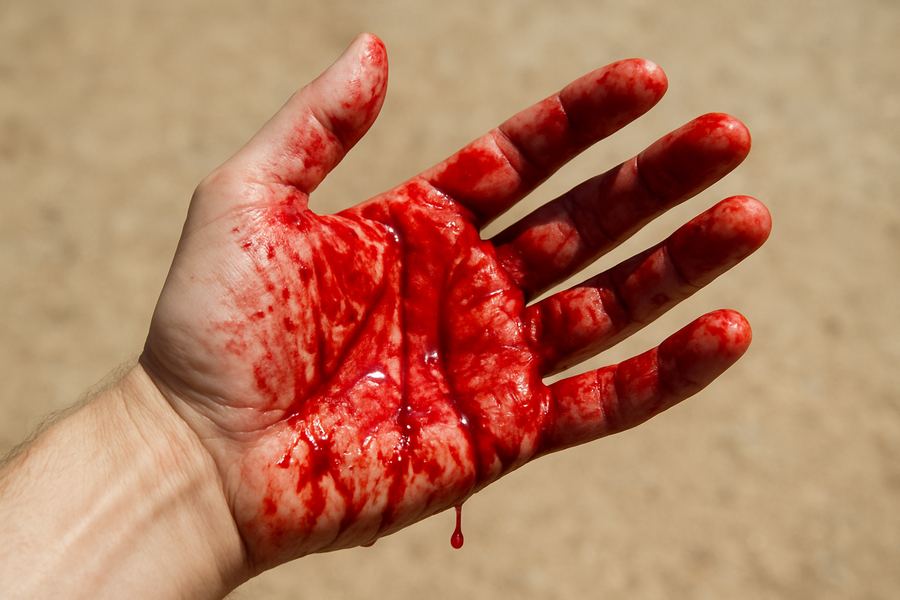
"Hi mom," Billy Hobbs cried out between rushing through the front door, stomping up the stairs to his bedroom, tossing aside his backpack and crashing on the bed. Another boring day at school was behind him. He settled into the cocoon of I-pod and head phones and surrendered his ears to another heavy metal assault while his head shook like he was being throttled. He opened the drawer beneath his bed and extracted his blood bank kit. It contained vials of O+, A+ and even some B+. He would have given the veins in his right arm for every enthusiast's Holy Grail: the elusive AB-.
Billy's arrival was a signal to his mother to begin preparing supper. It was one of her most beloved times of day. For the kitchen was her favorite room in the house. Its décor certainly reflected her personal
esthetics. She'd bought the miniature Sweeney Todd barber's chair in the gift shop of a theater where Stephen Sondheim's musical was being performed. It held pride of place on the sideboard between her Jack the Ripper 100th anniversary spice rack and her microwave, the one with the Hansel and Gretel decals plastered on the inside of the glass window.
She'd plop a carrot in the tiny chair, hum a Sondheim melody while slicing and dicing the vegetable from the head down. When it came to peeling potatoes, she'd draw inspiration from the print above the stove, the one of Michelangelo's "Last Judgment." St. Bartholomew and speckled spud were always ripe for flaying. St. John the Divine, of course, would have looked on in horror as she dropped the stripped potatoes in boiling water were he not, in the gold- framed picture atop the Ancient Mariner cookie jar, meeting a similar fate.
"What's for dinner, mom? I'm hungry." After an hour of being driven to near-deafness, he'd pop into the kitchen to give thumbs up or down to that night's menu. "Have you done your homework?" "Sure," he lied. "Any good massacres?" "No. We're reading about the constitution."
Such a pointless old document, thought Mrs. Hobbs. She was often aggrieved that the eighth grade history assignments never included Lizzie Borden. "I'll call you when it's ready."
Billy went outside to play with his friend Ivan. Mrs.
Hobbs smiled as she saw the two boys through the window tossing a football back and forth. Then she chopped some ice under the withering stare of an old sepia photograph of Trotsky.
As she turned on the gas stove, she whistled that favorite song, "The Ballad of Caryl Chessman." She grabbed a thawed chicken, slapped it down on the counter, began gouging out its innards. When she was done, she pinned a simple message on the carcass, signed, "From Hell," placed it on a pan, shoved it into the oven with a plaintive cry of, "This one's for you, Jack."
As the bird sizzled and the potatoes hissed and the cries and grunts of Billy's and Ivan's hand to hand combat wafted through the kitchen window, Mrs. Hobbs plunked herself down in a kitchen chair. She reached over for the framed photograph that always occupied pride of place on the kitchen table. It was a glossy, professionally shot, of her husband, Anthony a week after a shiny hook had been attached to the stump of his right arm. He was smiling as well he might. Her heart was warmed like Joan of Arc on the burning pillar at Vieux-Marché.
"What happened?" her friends had asked when Anthony came home from work with blood spurting everywhere "Accident on the job?" "Chainsaw?" "What's it like to live with a man who has a hook for a hand?"
The truth was she had dreamed of a husband with just such an apparatus since she was a little girl. Her mother often read to her from "Peter Pan." She identified herself with Wendy but she couldn't understand what all the fuss was about when the girl was tied to the mast of the pirate ship by that suave hunk, Captain Hook. The truth was that Anthony had severed his hand above the wrist intentionally, just for her. He was that kind of guy.
She loved him dearly, couldn't imagine life without the man. And this was why, even when he took a long hot bath beneath the print of David's "The Death Of Marat", she resisted the urge to plunge a knife into him. She had a similar reaction when seeing him seated in his favorite parlor chair before a background of wall-paper decorated with a lovely print of the bodies of Bugs Moran's men after the St Valentine's Day Massacre. Despite how she would have loved to see Anthony as a bullet-riddled corpse, that temptation remained in its holster.
It was ironic that poor Anthony's death did not occur by her hand but when he accidentally fell down the stairs one morning and shattered his skull. The night before, they'd watched "Kiss Of Death" together for the hundredth time. There was something reassuring about Richard Widmark giving the old lady a shove off the second floor landing. The repeated bump of head on wood was like the beat of a heart madly in love.
But she still had Billy--and how he reminded her of Anthony. Of course, he still had two good hands. Any hook in his future would be entirely up to him.
"Great meal, ma," said Billy after he'd swallowed the last of his chicken. "Mrs. Polanski called. She says Ivan lost a lot of blood this afternoon." "Tell her not to worry. I know where it is."